What is it?

Looking through my journals and email, I found out that I was wishing for a lot of good things to happen. I claimed to be “hoping,” but I did not/could not be confident the desired outcome would happen. That is not what hope is about. Hope is more than wishing. [Want to know more? Click here.]

Showing posts with label Prayer. Show all posts

Thursday, March 19, 2020

Seek the Lord Jehovah


Picking back up in 1 Kings, some time has passed. The Scriptures do not explain the hows or whys but at the beginning of chapter 22, King Ach’av (Ahab) of Israel and King Y’hoshafat (Jehoshaphat) of Judah had become allies. They met to form plans for battle against the occupiers of Ramot-Gil’ad that was in the ancestral lands God had given Israel.
The two kings agreed to fight together, but Y’hoshafat had a request before they finalized the plans. Verse 5 (CJB) explains: “But Y’hoshafat said to the king of Isra’el, ‘First, we should seek the word of Adonai.’” Ach’av assembled the prophets (who were not Jehovah followers) and they all did their song and dance rituals. They determined God would provide a great victory for the joint armies of Israel and Judah. But Y’hoshafat was not satisfied.
But Y’hoshafat said, “Besides these, isn’t there a prophet of Adonai here that we can consult?” The king of Isra’el said to Y’hoshafat, “Yes, there is still one man through whom we can consult Adonai, Mikhay’hu the son of Yimlah; but I hate him, because he doesn’t prophesy good things for me, but bad!” Y’hoshafat replied, “The king shouldn’t say such a thing.” (Verses 7-8)
So Mikhay’hu (Micaiah not to be confused with Micah) was summoned, probably from a dungeon where Ach’av had him for safekeeping and out of his way. Micaiah gave the kings God’s message, which was unfavorable for Ach’av, predicting he would go up to battle and be killed. Y’hoshafat was actually spared being harmed, while a random arrow struck Ach’av “between his lower armor and his breastplate” (verse 34). There is much more to these events, but I’m going to focus on one aspect, an aspect we can and should all do.
What did Y’hoshafat do that was different than Ach’av? Why was he spared while Ach’av was not? I’m not sure of all of the possible answers, but one thing stood out to me. Y’hoshafat sought the true God’s (Jehovah’s) words. He did not settle for words from the wise men of his era. He did not read every note from the people. He did not rely on anything but God. I’m also trying to not rely on Facebook or TV news or rumors for my information. All I really need to know is what would God have me do next.
So we also need to seek the one true God’s will and commands when we are getting ready to go to battle. Our battles these days have to do with the uncertainty of the future, both immediate future and long-term future. Who would have thought that the state of the United States (even the world as a whole) would be what it is today. Very little is “normal.” There is fear, social distancing, economic worries, and so, so much uncertainty. Even the “experts” in the fields of medicine cannot agree on the facts about the coronavirus sweeping the world.
I can easily let a sense of unrest and fear overwhelm me, however, I daily (and moment to moment) pray to God. I especially acknowledge His greatness, power, and plans for victory. It’s the most and the least we can do. We can approach major decisions as Y’hoshafat did. Seek out God and His Word for direction. Turning to God will be our salvation from the worries of these times. I don’t assume to understand His answers, and I don’t even know what tomorrow holds for us, but I rely on the One who does.

Thursday, October 24, 2019

Don't Give Up


Mental health issues are a big part of my life. Lately I’ve been feeling the effects of my cycling patterns with my bipolar disorder, the changing of the seasons, having less daylight, and various life events. I’m depressed.

I’ve searched and prayed for permanent answers so I don’t have to deal with these aspects of myself. I’ve tried to believe that God expects us to be happy all the time. (Notice, I said “happy.” That is distinctly different from the joy I have in knowing Christ and looking forward to the fruition of His eternal promises.) I am coming to a point of acceptance that happiness is just an emotion like any other, and it will come and go from time to time. Just like I should not expect anger, loneliness, or despair to totally disappear from my life as a human being, I cannot expect that happiness will be a constant. God did not create us as robots. He gave us emotions for a reason – I’d say, for information – that we are better able to know Him and serve Him. I can’t say I have it all figured out yet, and probably will not as long as I walk on the earth. I can learn to deal with them in appropriate ways, and I get tremendous help from the Scriptures.

That said, I read Luke 18:1-8 for my Quiet Time one morning this week. This passage is the parable of the judge that was worn down by the repeated appearance and requests of a widow woman. Luke’s narration in the first verse, which introduces the parable, challenged me. I had just written down on my “emotions chart” for my therapist that the primary emotion for the last week has been “discouraged.” Then I read the passage and verse one summarized one of my problems right now. In the Amplified Bible it says,

"Now Jesus was telling the disciples a parable to make the point that at all times they ought to pray and not give up and lose heart,” 

Other versions say “never quit” (MSG) and “faint” (KJV). So I looked up “faint” in Abingdon’s Strong’s Exhaustive Concordance of the Bible (this resource is keyed to the King James Version of the Bible and gives the exact Hebrew (Old Testament) or Greek (New Testament) word with a brief definition).  The Greek word is “ékkakéo.” Strong’s indicates this means “to be bad or weak, to fail (in heart):-faint, be weary.” Looking for more synonyms, I used W.E. Vine’s An Expository Dictionary of New Testament Words: “To lack courage, lose heart, be fainthearted.” I think those words imply that we can do something about the situation to avoid staying discouraged. Note in verse one it says we need to pray at all times, frequently, consistently, and always, depending on the translation. Further, I think it means we are to expect God to answer because He wants to answer. The parable tells of a widow who wore down a civil judge (who did not fear God), and although he didn’t really want to give in to the woman’s request, he did. We don’t even have to try and wear God down. He wants us to ask Him and He wants to answer us, but He wants us to ask Him. He’s just waiting for us to ask (see John 16:24).

So, next on my agenda is to try and figure out what the discouragement is about and pray, and pray again as I encounter discouragement during my days. Figuring out what the discouragement is about will be difficult so my prayer might just be “Help me in my discouragement.” By laying my troubles at Jesus’ feet through prayer, His peace will come over me, even if five minutes later I have to pray again (Philippians 4:6-7).

Thursday, April 4, 2019

Making Decisions


Recently I had the thought to revamp my weekly schedule. I came up with a “brilliant” idea all by myself. The goal was to make more time for writing. As I mapped out in my head what I was going to do, I made assumptions based on my superior intellect. I assumed I’d be stellar in my writing performance without the activities I was cutting out. One was an AA meeting at 8:15 on Monday mornings, and the other was my volunteer work at a mission in my town on Thursday mornings. As I said, I had it all mapped out in my head.
As I said last week, last Tuesday I spent some extended time with God, reading His Word and asking for guidance. I also said that a key thing I received from that time was ideas about how, when, and who to be praying (basically it was before, during, and after I write). The other main lesson was that I should make writing (God’s calling on my life) a priority in my schedule. So I decided to schedule writing time into the time slots I freed up by skipping the meeting and volunteering. I should’ve prayed some more . . .
In 2 Samuel 6 we have the story of David moving the ark of God to Jerusalem. David also made some assumptions about how things should be done. He decided to move the ark the way the Philistines had returned it to Israel (that account is found in 1 Samuel 6). David did not even consider searching the Scriptures or asking the priests to examine the Scriptures to see if God had given any instructions in how to move the ark. As a result, tragedy struck and one of the attendants tried to steady the ark as the oxcart it was in looked like it was going to turn over. That attendant, Uzzah, died immediately upon touching the ark.
David decided to leave the ark in a nearby lodging of some Levites and go back to Jerusalem without the ark. The passage in 2 Samuel 6 says David was upset and frightened of God that day (vs. 8-9). He was afraid of what trouble the ark of God might cause for him and he didn’t want it in or near his capital city. After three months everyone was talking about how the people the ark was left with were prospering above and beyond what was normal. So David decided to move it again.
This time he must have studied the Scriptures and found the passages that explain how God’s ark is to be handled . . . using rods through the designed rings on the ark and having the Levite clan of Korhath bear the ark on their shoulders. It doesn’t say in the text that David did his research and/or consulted wise counsel, but he must have because he knew how to move the ark this time.
Back to my story. My scheduling plan was to take action without consulting God or wise counsel. But I paused – probably the Holy Spirit’s nudging – and sought counsel. My therapist and AA sponsor both told me the same things. Start with every other week so I can keep my accountability in AA and continue to serve world missions by the volunteer work. With further counsel and much more specific prayer, I freed up one day a week to devote to writing by going to the meeting and the volunteering opposite every other weeks. A much healthier plan than I thought should be done.
Are there areas or decisions or actions on which you need to be consulting God? I know there are many other situations in my life where I try to make the decisions for myself and the results do not work out as well as I thought. My goal is to seek God’s Scripture wisdom before I act.

Thursday, March 28, 2019

Key to Success


Sometimes getting things done seems like a huge task. I get weighed down with the weight of my concerns, worries, and even the things I’m looking forward to. I’m so caught up in these concerns that I don’t recognize when or if I’m successful. And, I fail to acknowledge the One who was successful thinking it was all my doing. I won’t recognize true success unless I’m focused on whom the success comes from.
It doesn’t matter what skills, intellect, talents, education, or experiences I have that can aid me in achieving tasks. Those things are just gifts from God. We can learn a lot about true success by looking at some aspects of King David’s life. We’ve already discovered some areas where David deviated from the Torah (Old Testament) Laws, yet he was successful in many of his endeavors.
In 2 Samuel 5, two battles against the Philistines are recorded (2 Samuel 5:17-21; 22-25). David succeeded in routing the Philistines both times, a task Saul had been unable to achieve many times while he was king. David’s army beat the Philistines so badly that the Philistines basically ceased to exist. What was the key to David’s success?
He gave the Lord God of Israel all the credit. We read in vs. 10, “David grew greater and greater, because Adonai the God of Armies was with him” (CJB). And in vs. 12 it says, “David then knew that Adonai had set him up as king over Isra’el and increased his royal power for the sake of his people.” In vs. 19, “David consulted Adonai, asking, ‘Should I attack the P’lishtim? Will you hand them over to me?’ Adonai answered David, ‘Attack; I will certainly hand the P’lishtim over to you’” (Again the CJB). In vs. 20b we again see David giving credit to God: “He said, ‘Adonai has broken through my enemies for me like a river breaking through its banks.’” Getting the picture? More references to David and his consulting and crediting God are verses 23 and 25.
I think I need to be seeking God, praying, and giving God credit for the outcomes. Today I spent some extended time with God evaluating what He’s been speaking to me about since January (used my daily Bible reading journals to see a pattern). One of the two things was to be praying more and for more things. In the back of my mind I’ve thought it might be good to pray before I write each week. I’ve heard other Christian writers say they pray for their audiences. I’ve heard stories of people who were devoted to prayer and as they expected, saw God’s answers played out in their lives. These are some of the things and ways I need to be involved in when I’m praying. What specific situations would God have you praying about? What answers are you expectantly waiting for? And, finally, what do you need to be giving credit to God for in your lives?

(CJB stands for The Complete Jewish Bible)

Thursday, January 17, 2019

Another Chance to Trust God


In 1 Samuel 26, we find Saul again pursuing David. And, again, David has the opportunity to kill Saul. And, again, David does not kill Saul. In verses 9-11, David gives two reasons for not striking Saul dead. David gives his companion, Avishai his cousin,  these reasons (based on notes from Matthew Henry’s commentary).
First, in verse 9, “. . . David said to Avishai, ‘Don’t destroy him! Nobody can raise his hand against ADONAI’s anointed without becoming guilty!’” (Complete Jewish Bible, CJB). Reason number one for not killing Saul is it would be a sinful affront to God’s ordinance. This issue of breaking God’s ordinances is taken up again in the New Testament. Romans 13:2 says, “Therefore he who resists authority has opposed the ordinance of God; and they who have opposed will receive condemnation upon themselves” (NASB). Since the ordinance is to not harm God’s anointed king, David recognizes that it’s not his place to harm Saul in any way. He wanted to be obedient to the commands of God.
In verse 10, “David then added, ‘As ADONAI lives, ADONAI will strike him down, or the day will come for him to die, or he will go down to battle and be swept away.’” (CJB).  The second reason David gives Avishai for not killing Saul is it would be sinful anticipation of God’s providence. David wanted to leave it up to God to determine the time and situation of Saul’s death. Assuming he had the right to decide that, and doing things his own way, would be sinful.
Pondering this, I realized that sometimes I make decisions that are better left up to God. I try to push my agenda and expect my desired outcomes regardless of what Jesus might want or have planned. I’ve seen it in my life and in the lives of others. We push our agenda and it doesn’t work out “right.” Things don’t go as planned. Usually, that results in anger and resentments. Sometimes that leads to further consequences and greater problems to be solved. This especially happens when I fail to take the chaos in my thoughts and situations to God in prayer – before I take some misguided action.
God has called us to be people of prayer. I’m making a new commitment in that area this year hoping for greater peace, direction, and a deepening relationship with God. As our Pastor, Mark Wilson, said Sunday, it’s the basis for a spiritual awakening for individuals and for the church. I want to be further awakened. Prayer and consulting God, before I act, is part of the solution.

Thursday, August 23, 2018

An Assignment


God had appointed a king over Israel through His man, Samuel. With this appointment of Saul as king, Samuel’s role changed. Before, Samuel had been God’s spokesman in all aspects of the Israelites lives. He was the “political” leader, the “governmental” leader, the “judge,” and the spiritual connection to God. Now, in 1 Samuel 12, we see his role shifting. The political and governmental leadership (and the people’s allegiance in those areas) was placed on the person of Saul, the earthly king that made them just like the other nations. Saul would also be responsible to set up a system to judge the people when there were disputes or wrongdoing.
In 1 Samuel 12:23 Samuel explains his new role in the kingdom of Israel: “Moreover, as for me, far be it from me that I should sin against the Lord by ceasing to pray for you; but I will instruct you in the good and right way.” Samuel’s ongoing assignment was to pray for the people, and instruct them, when asked, “in the good and right way.” He went on to give them some instruction in verses 24-25:
Only fear the Lord and serve Him in truth with all your heart; for consider what great things He has done for you. But if you still do wickedly, both you and your king will be swept away.”
This caused me to consider what my assignment is. Samuel’s was to keep praying and listening to God. I think God gives Christians many “assignments” from studying His Word to being kind and considerate to others. One of these assignments is the same as it was for Samuel: to pray on behalf of people.
God has been bringing this issue to my attention for quite some time now. Back in January of 2016, I was prompted to start using a “prayer journal” again. I started one, writing prayer requests and answers down inconsistently from January to August. Then I started again in January 2017 writing a total of 7 requests down during 2017 (all in January). In 2018, I again opened my prayer journal beginning in April and was more consistent than in the previous years. Yet there are many missing days.
That’s not to say I didn’t pray. I pray all through my day, everyday; however, it’s not intentional, dedicated prayer time. These short, on-the-go prayers have been answered and I continue to pray many of them as I go about my days. I’m not saying that doing that is wrong – even if it’s the only kind of praying we do. I just feel that God has given me an assignment to be more intentional about my prayers. He wants me, for my own mental health, to write the prayers down, pray them through regularly, and make notes of answers to the prayers. When I do this, I am so encouraged and am able to trust God to a higher degree. And, in keeping with Philippians 4:6-7, God’s peace washes over me even as I wait for the prayers to be answered.
I want that kind of peace in my life. My intention is to be as committed to prayer as Samuel was. That starts today.

Thursday, May 24, 2018

God is Righteous and Just


Today in my time in God’s Word, I was presented with the righteousness and justice of God. Let’s not succumb to the idea that because God is love He is only forgiving. He does those things: loving and forgiving. However, He is also jealous and holy.
This is a hard subject to broach in today’s Christian churches. We focus on His salvation and love and caring spirit to attract others to the hope of salvation. However, if we leave out the part about separation and disobedience, what is there to be saved from? Let’s not be fooled into thinking that saying we believe in Jesus is enough. Even the demons believe in Jesus. Let’s not be fooled into thinking that God will save us and provide everything we want, just because we profess Him as Lord.
His plans are unsearchable to us. What we want may have nothing to do with His plans. As I discussed last week, our prayers need to be in line with His will. Our behavior also has to be in line with His will. His will is that we are intimate with Him. Not just saying the right things and sounding good, but truly knowing Him and serving Him. This doesn’t just happen because we prayed some prayer (although that’s a good start). Knowing Him means communicating with Him. Two-way communication. It’s not just praying to Him. And it’s not just reading His Word and listening for His Holy Spirit’s guidance. Both of those behaviors are essential for really getting to know Him.
Part of knowing Him is realizing that He’s a jealous God. He wants nothing or no one to come before Him in our lives. He does discipline those who fail to make Him the priority of their lives. I’m not just talking about those who are not Christians. He disciplines each and every one of us – possibly especially those who say they follow Him – when we don’t make Him the priority in our lives. The discipline can be harsh. In Old Testament times it meant He pruned away some of those He called His own. His character does not change. He will also prune away some of those that He now considers His own in faith. He does what is best for His plan.
I don’t pretend to understand exactly what He’s thinking. I just know He’s not easily fooled by good sounding words or self-serving service. We can volunteer at church, pray publicly in restaurants. We can proclaim Him to others, sound like we know the way. We can read His Word and study the commentators. We can be teaching Christ to our families, sharing Him with our friends. Yet we can still place other things before Him, and He will know. He is a jealous God! We need to examine our hearts and minds. We need to be doing all these things for His glory. We need to have no other “gods” before Him. He is righteous and a just judge. He will not be fooled by our thoughts, feelings, actions, or minds. He will discipline, even to the point of death, any who put other things ahead of Him.

Thursday, May 17, 2018

Answered Prayer


On Tuesday, I will have/had hand surgery. Nothing major, however, it will prevent me from making posts for a week or so. I usually write my blog articles on Tuesdays and scheduled them to be posted on Thursday mornings at 2:00 am. This week, I’m writing this on Monday and scheduling it to be posted on Thursday. I don’t know when I will be able to post again but I’m aiming for a couple of weeks.
I’ve been reviewing some key passages of Scripture with a friend the last few weeks. With that review comes Scripture memory review of some foundational verses. The first one is entitled “Assurance of Salvation.” I shared that verse last week in my article about how to do Scripture memory. This week the verse is “Assurance of Answered Prayer.” John 16:24 says, “Until now you have asked for nothing in My name; ask and you will receive, so that your joy may be made full.” The key is in asking according to His name and abiding by His standards and will. When we ask for the things He’s promised us in the Scriptures, He will answer. When we ask for things that are actually good for us, He will probably answer (however, sometimes the things we think are good for us may, in fact, be harmful for our walk and worship with God). When we ask for God’s will to be done, and trust He will work things out according to His plan, He most definitely will answer.
I’ve found the promise in this verse to be true. When we ask in His name, my joy is made full. I find peace and contentment in my life. I find things for which I am thankful. I am abundantly filled with rejoicing and praise. My life is grand and there is so much to look forward to. I wait expectantly to see just exactly how God answers my prayers.
There’s another reason I wait expectantly for the “answers.” Romans 8:26 tells us that the Spirit is praying for us when we don’t even know what to ask: “In the same way the Spirit also helps our weakness; for we do not know how to pray as we should, but the Spirit Himself intercedes for us with groanings too deep for words.” Since I don’t even know what to be praying for, and the Spirit is praying for me, I may get answers I never expected.
So, I will do what John 16:24 says and pray in Jesus’ name. Then I will wait expectantly to see the grand answers God gives me.

Thursday, April 5, 2018

Acts 12: Fervent Prayer


When I was writing about the Book of Acts, I did not write anything specific about Acts 12. Here are some thoughts I had as I was rereading this portion of Acts this week.
Most of Acts 12 gives us an account of a miracle involving Peter. Herod Agrippa I, the grandson of the Herod the Great who ruled at the birth of Jesus, was now ruling in Jerusalem. He was supposedly a “zealous practicer of Jewish rites and a religious patriot (Ryrie Study Notes).” In Acts 12 he was busy rounding up the believers still in Jerusalem “in order to mistreat them (vs. 1).” “And he had James the brother of John put to death with a sword (vs. 2).” The mistreatment seemed to please the Jews so he also had Peter arrested and thrown in jail.
Peter was chained to guards and other guards were blocking the doorway. Just before he was to be brought to Herod for judgment, the miracle happened. An angel came and broke the chains, opened the doors and escorted Peter out of the prison. Once free, Peter realized just what God had done by sending an angel to rescue him. Peter went to a specific house where he had probably been many times. We can assume he knew people would be there praying.
In verse 5, we have a description of what was going on in that house: “So Peter was kept in the prison, but prayer for him was being made fervently by the church to God.” This is a challenge to me. Is my prayer “fervent?” Is the prayer being made in my church “fervent?” According to Merriam-webster.com, fervent is defined as: “exhibiting or marked by great intensity of feeling: zealous.” Great intensity. Can my prayer life be described as having great intensity? I think I’ve rarely been in a situation where I would describe the prayer as being fervent.
At an Easter Sunday service at my church recently, the Pastor was explaining the gospel message tracing Jesus’ role from Genesis to Revelation. There was an opportunity for people to come forward if they had made a decision to follow Christ during the last year or if they were making first time decisions right then. This was a cause for fervent prayer. Throughout the services, there were people praying – individually and in small groups. I think I experienced fervent prayer as I was part of one of those small groups. However, it was relatively short-lived compared to the all-night praying of the early church for Peter’s situation.
I also wonder if we prayer fervently for those in our world today who are imprisoned for the sake of the gospel. I’m convicted by my lack of knowledge of such people around the world. I know there are some, possibly many, but I just don’t know any specifics about them or their situations. I do, however, have first hand experience with situations in Haiti involving social unrest, poverty, health concerns, and educational issues. I can be fervently praying for the people I met and those who are on the front lines trying to minister in those difficult situations. I need to do more of that. I think we also should all do some research into which and where people are imprisoned or under persecution for proclaiming the gospel of Jesus Christ.
I think there’s a place for fervent prayer in our world today. Maybe even more so as the time of Christ’s return is closer everyday. Am I, are you, praying angels into situations where believers need divine help? I’m going to start doing more of that kind of praying.

Thursday, February 22, 2018

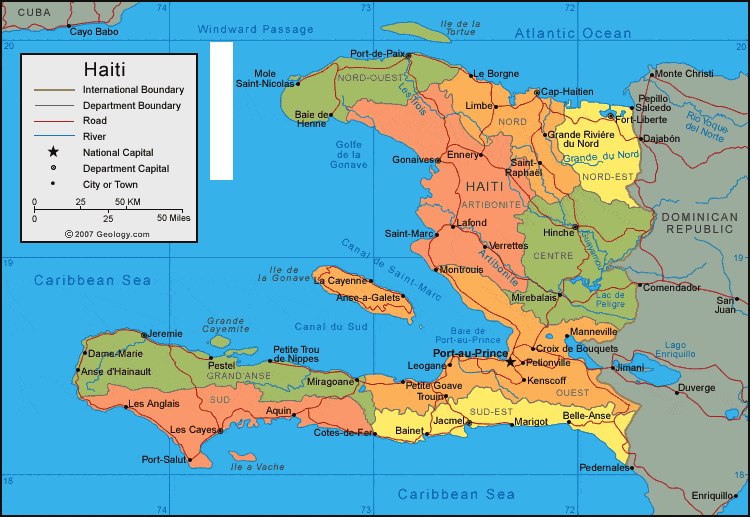
Haiti Part 4


More about the third day. Last week I described what we did in the morning of January 22. The afternoon was spent doing the key thing on our agenda (and what we would spend the next couple of days primarily doing).
We assisted LSM’s Haitian team build roofs on several houses. Specifically, on the third day, we completed one roof in the Cavaillon area of Les Cayes. The roofs had already been roughed in with pole rafters. Our job was to help “flesh out” those rafters giving nailing surfaces for the tin that was to be attached as the final roof. Three of us were moving around the roofs with the efficient and skilled Haitians, doing this work. One was involved with on-the-ground preparation work and handing materials to the men on the roof. My role was to be a “go-for” going for various items the roofers needed, such as water bottles, more nails, and various tools.
When not getting things for the roofers, I tried to stay out of the way and mingle with Haitians who had come to watch the construction. I was not very good at it due to the language barrier, but most of the children loved having their photos taken and then looking at the digital displays on our phones. Often I found myself sitting in the shade praying for the projects, the men, the attitudes, and that we would truly be helpful in building the various roofs.
A little about the roofs. Some of the homes we put roofs on had lost their roofs (and most of their walls) during the hurricane from a year and a half ago (Matthew). The houses had been only marginally useful to the owners and the new and improved roofs of tin were greatly appreciated. Some of the families had been living with other families since the hurricane. With the roofs they were one step closer to moving back into their own homes. Others had been using thatch for their roofs. Thatch (made from straw, reeds, palm leaves, etc.) was available but leaked. It was also dislodged by storms and wind. Tin roofs are wonderful replacements and would keep the families dry for many years to go. The Haitian “crew leader” said that in normal conditions, a tin roof could last for up to ten years. That’s a marked improvement from the thatch!
Just as we returned to our lodgings at the end of the day, it started to rain. Our prayer was that the family had been able to get their belongings moved back into their newly roofed home before the rain, and was able to enjoy a dry shelter.

Thursday, February 1, 2018

Haiti Part 1


I don’t know if you expected this or not, but I’m planning to write a series of sorts about my experiences and God’s work in my life based on my recent mission trip to Haiti. I learned so many things, and God laid so much on my heart, that deciding what to write about will depend heavily on the journal I kept while there (and continuing now as God still gives me insights based on events from the trip). I am also grateful to Loving Shepherd Ministries (LSM) for the opportunity to serve along side them. (https://loving-shepherd.org/about-lsm/)
On Day #1 we traveled to Fort Lauderdale, Florida via Dallas/Fort Worth. Going through security checkpoints was a little scary. I was afraid that one or the other of my carry-on luggage wouldn’t pass muster for what is allowed. I was mostly afraid they would be too big or that some of the contents would not be allowed. I, of course, had an abundant supply of my various meds and supplies for my insulin pump and glucose meter (some of which have sharp things associated with them). I had done thorough research on the TSA website as to what is allowed and what is not, but there was a nagging feeling that I would be without something I needed in Haiti.
However, God is faithful. I had figured out from the way my support for this trip came in that God wanted me in Haiti. I should have taken some of that confidence with me to the airports. I had no more problems that anyone else did. (They did “inspect” our various snacks we took along. I’m not sure what they were looking for but something sent alarms off as they passed through the scanning equipment. Also, in Fort Lauderdale, before boarding the plane to Port Au Prince, Haiti, they hand inspected my diabetes supplies, but let them go through without a word.) God still wanted me in Haiti. God is faithful.
Not having flown much in airplanes, I was afraid I would not do well and get motion sickness or something else. My ear pressure was uncomfortable on take off and descent, but not unbearable. I did not get sick in any way, and actually enjoyed most of the flights. I wish I had taken some ear buds or some earphones since to watch the movies I needed them. Just a suggestion for others who might take long flights: Take some.
That pretty much covers the first day. It was a day of travel and a day in which I had much time to pray and praise. I asked God to prepare my heart for the adventure ahead. He partially did that through my time in the Word that day, 2 Peter 1:1-9. This passage talked about how God is keeping “His precious and magnificent promises, in order that by them you might become partakers of the divine nature” (vs. 4). As God keeps His promises to us, we are to reflect His nature by also keeping our promises. I knew not to promise to the people of Haiti what I could not deliver upon. We should be demonstrating God’s character by keeping our promises. This concept was important to me as the Haitians had so little and I wanted to provide for them the world, but I just can’t. My service would have to suffice (and it would be much appreciated by those we served).
More next week. We will see what God lays on my heart to share with you then.

Thursday, January 25, 2018

Thoughts on Prayer


I’m actually writing this last week. This week I’m in Haiti serving God wherever and however He leads. In getting to this point, I’ve seen some miraculous answers to prayer. Many people have been praying for me, just to get me to Haiti. Those prayers have been answered.
Many people continue to pray for this mission trip. Maybe some of you have been praying since I initially wrote about this trip on November 23, 2017 (you can look that up by choosing the date from the list of blogs on the left side of this page). I thank you for those prayers. Please continue this week. (We are scheduled to be home on Saturday, January 27).
One of the things people have been praying for is the finances. I didn’t have much time to raise support and I was prepared to spend my “new computer savings money” to round out the balance. However, GOD came through in a big way. In about four weeks, people gave enough to cover my expenses and to provide extra towards materials and supplies for the various projects on which we will be working. I’m grateful to these people, but I’m also very grateful to God for working in people’s hearts to give, and give generously.
I’m expecting to talk more about the various God-sightings from this week in future blogs. Please pray we will see God at work and rejoice in Him. Please pray we will accomplish out goals (one of which is to build six roofs while we are there). Please pray for our safety as we travel and mingle with the people of Haiti (specifically in Les Cayes on the south side of the long, skinny peninsula, about four hours from Port-au-Prince by car). Please pray for the health of the team (six members including myself; five men and me!) Please pray we will be excellent witnesses for Christ and good representatives of what some Americans are like.
Thank you in advance for your prayers. A report will follow shortly.
                                            Les Cayes                     

Thursday, December 28, 2017

Trying to Look At the Big Picture


The study of the book of Daniel is winding down (two chapters to go). My Bible study partner suggested we try looking for the big takeaways from the book and our study. While much of Daniel, especially chapters 7 – 12) deal with various visions and dreams Daniel had, the first part covered the various Daniel “stories” we learned as children. There are, however, some common themes throughout which span all parts of the book.
Early we saw Daniel and his friends making stands for God and for living according to the Law even though it was not convenient to do so living in Babylon. There were several situations described where these young Jews chose to obey God even though it meant scrutiny and persecution from the Babylonian culture. A couple of results for staying steadfast were being thrown into the fiery furnace and being fed to the lions. This dedication to God continued to be a vital part of Daniel’s character. As a result, God was able to use him to interpret dreams and have some understanding of visions God gave him.
For us, we need to be obedient to God’s way of life. We need to be intentional and focused in what we do and say. Daniel kept himself pure because he had purposed in his heart to do so (chapter 1). Daniel arranged his schedule so he could pray three times a day, as was the law and customs of the Jews. Daniel approached every situation by appealing to God. He set his heart on upholding God’s ways in every situation – even if it put his life in danger (kings don’t like bad news). We need to do the same as the culture we live in today in a “foreign” culture, not at all what God wants for us, full of temptations and disobedience. We need to be intentional to live differently.
Another takeaway is the importance and urgency of the practice of prayer. Throughout the book, Daniel approached God for help, and God sent His angels to meet Daniel’s needs and help him proclaim God’s message to the rulers he served. He didn’t just pray in crisis. It was his habit, a daily – three times a day – practice. There are several examples of prayer in Daniel, but the most convicting for me is in chapter 9. Daniel’s prayer of praise and confession is recorded, and it’s a great pattern for us to follow when we come before God in prayer.
One more takeaway from the book of Daniel is the fact that God is in control. He made things happen and happen in certain ways. He gave Daniel prophecies and is fulfilling them. The 400 “silent” years weren’t without God’s activity. He told Daniel much of what would happen during that time, and those prophecies have come to pass in human history. Kings came and went. Wars were fought. Empires were formed. There’s still much to come according to Daniel’s prophecies, but we can be assured that God is working even now to bring those things to pass. His Words are true and have always been fulfilled. We can look forward to the final day when He fulfills the prophecies of a new earth and the eternal rule of Christ our King.
There may be some other possible themes or applications to come. We will see what pops up as we work on completing this round of studying the book of Daniel.

Thursday, December 14, 2017

Burdened For the World


Daniel’s prayer and praise in Daniel, chapter 9:1-19, convict me. There are several key elements in this approximately three-minute prayer to which my attention was drawn.
First, Daniel may have intended to be long-winded, but God sent an answer while he was still praying. In verse 21 Daniel tells us, “while I was still speaking in prayer, then the man Gabriel, who I had seen in the vision previously, came to me . . .” I often think I’m not praying enough meaning my prayers are too short. However, God heard Daniel and responded quickly. One commentator suggested that God heard Daniel right away and it took Gabriel three minutes to get to him. Or, the commentator suggests Gabriel got there right away but stood by, shifting from one foot to the other, waiting for Daniel to notice him. Either way, God sent His answer quickly, not after long hours of prayer as I often suppose has to happen.
Second, Daniel prayed with understanding and earnestness. Verse 3 says, “So I gave my attention to the Lord God to seek Him by prayer and supplications, with fasting, sackcloth and ashes.” He also started off with praise and confession. Verses 4-5 say,
I prayed to the Lord my God and confessed and said, ‘Alas, O Lord, the great and awesome God, who keeps His covenant and lovingkindness for those who love Him and keep His commandments, we have sinned, committed iniquity, acted wickedly and rebelled, even turning aside from Your commandments and ordinances.’
Notice, he included himself in the confession. There is no record of Daniel’s sin in the Bible, but from his own mouth we know he sinned. He was pleading on Israel’s and his own behalf for forgiveness. However, I noticed that throughout the prayer, he acknowledged God’s character and promises. He acknowledged how they had sinned against all the commandments that God had provided them through His ordinances and through the prophets. They had rebelled in spite of God’s goodness.
And, third, Daniel’s heart was burdened for all the people and for God’s glory to be highlighted. My heart is now sufficiently burdened for mankind and that the glory of God, through the sacrificial act of Jesus Christ’s life, death and resurrection, be made known throughout the world – starting with me wherever I go and whomever I talk to. I also need to pray and keep in mind that it’s all for God’s glory. We are made for Him, not Him for us. We should be about the business of God, proclaiming Him and loving in His name. If I’m truly burdened for the world, I need to take every opportunity to share Christ, as He is the only hope in the world and through Him we learn to give God all the glory and praise we can. No matter how much we acknowledge God and point others to Him, it is not enough. He deserves so much more than we can humanly give Him. Being burdened for the world (our sin included) and trying to bring glory to God go hand-in-hand. Keeping both those perspectives in mind allows us to know true joy and peace.

Thursday, September 21, 2017

Intimacy With God: Meeting a Need in My Life


Over the last 12 weeks or so, I’ve been sharing with you about the insights I’ve gotten from doing the Intimacy With God Bible study, by Cynthia Heald. I shared how my intimacy with God has grown and changed during this time (and hope continuing on from here). I can now say that my intellectual attachment to God has grown. That was always my strong suit before, and now it’s stronger. I rarely felt emotionally connected to God, but that has changed. As a result, I’m more able to see God at work in all areas of my life. I encourage everyone to develop both sides of their intimacy with God, and if you need help, invest your time and resources to studying Intimacy With God, by Cynthia Heald.
In writing my blog articles about intimacy with God, I mentioned several times how these concepts were helping me deal with the struggles in my life, as they were happening. What I didn’t tell you was what those struggles were about. I realize I’ve mentioned some of my various struggles in the past: mental illness, alcoholism, insulin-dependent diabetes, general fears, and various anxieties. However, since March, I’ve been dealing with something new: CANCER.
Follicular Lymphoma Grade IIIa, to be exact. I noticed a lump in/on my neck in late February and, after some urging from my therapist, I made an appointment to see my doctor. He thought it was “strange” also and referred me to a Ears, Nose, and Throat (ENT) specialist. After a couple of needle biopsies and a CT Scan (and lots of waiting in between each procedure), it was decided that in order to get an accurate diagnosis, some surgery was needed (on my left neck area where the lump was) to remove as much of the tissue as possible from which more biopsies could be done. That surgery happened on May 31st. It took almost two weeks to get any results from that, but when all was said and done, it was cancer.
I was referred to Oncology (Cancer Center) and after waiting some more, and seeing a doctor there, more tests were ordered, after which there was more waiting. Those tests revealed that the cancer, as far as they could tell, was not systemic and, therefore, Stage One. The course of action would be radiation treatments. So I was referred to a Radiology Oncologist. After a few more procedures and tests and scans, a protocol was set up for my treatment and I began treatments on July 31st. I went every weekday through September 6th for about 10 minutes of treatment. I was able to schedule the treatments for early afternoon each day and kept my usual morning routines as much as possible.
Now that stage of my treatment is over. However, I’m finding I need even more intimacy with God to deal with the “surveillance” stage, where there’s more waiting to see if the cancer is gone, shrunk, whatever. There are more CT Scans in my future, but right now I’m just in a waiting and trusting mode. Trusting God has become easier since I’ve been getting to know Him better through greater intimacy. As I said in my last blog article, I’m continuing to do several important things for depending on God, in all His greatness, as I draw closer to Him.
Maybe that’s why He didn’t urge me to tell more people about this. He wanted me to trust Him and lean on Him. On Him alone. Not on the prayers of others. Not on the sympathy of others. Just on Him alone. I think He led my Bible study partner and me to this study just so I could enhance my walk with Him and grow closer to Him. I’m going to continue looking for examples of Jesus’ intimacy with us and I’m going to continue to work on deepening my intimacy with Him. I’m seeing it everywhere now. Like in Psalm 5:3, I will turn to Him each and every day and order my life around my trust in Him. That verse says (I quoted it last week, too):
In the morning, O Lord,
            Thou wilt hear my voice;
In the morning I will order my prayer to Thee
             and eagerly watch.
Yes! In the morning. But also throughout the day as I review and memorize Scripture, study His Word, and spend time devoted to praising Him. And, sharing as much of Him as is possible with those who need to know Him better.
What can you do to grow more intimate with God? That is my challenge to you today!

Thursday, August 3, 2017

God Is Responsive


God is responsive. In other words, He’s paying attention to us and answering our prayers – even those we didn’t know to pray. I’ve memorized and studied verses that tell us that God answers prayer, but I think I saw that as a child asking Santa for things on their wish list. I didn’t take into account that God knows better than I do what I really need. He responds to the situations in our lives, not just the things I remember to pray about. Of course, we have to recognize that sometimes His answer are “No,” or “Wait.” However, we can be certain that He is at work giving us whatever we need to live for Him.
The Psalmists recorded their experiences with God. They cried out, they trusted, they sought, and they feared (revered) God, and God responded in many ways:
·      Answered
·      Delivered
·      Saved
·      Rescued
·      Redeems
·      Satisfied
·      Lead
·      Had compassion and grace
·      Raised up
·      Gave food

Many passages of Scripture tell us why God takes care of us so well. It’s all because of His lovingkindness. Another word for lovingkindness is mercy. It’s hard to imagine the depth and breadth of God’s love for us. I’m not sure any of us can fathom the totality of God’s loving character. His love is what makes all things possible for us, from being rescued to eternal life. However, the Psalmists also recorded some areas we have responsibility for so God’s answers will be seen and recognized. In Psalm 34:11-14 explains some of the responsibilities:
Come, you children, listen to me;
I will teach you the fear of the Lord.
Who is the man who desires life,
And love length of days that he may see good?
Keep your tongue from evil,
And your lips from speaking deceit.
Depart from evil, and do good;
Seek peace, and pursue it.
So, we are to keep our tongues from evil and lips from deceit. We are to depart from evil and do good. We are to seek peace, and pursue it. In other words, be righteous before God. Without God’s love and power we are unable to do those things, and we have to do these things to see God’s answers to our prayers, which include the ability to avoid evil and deceit, the ability to do good, and the ability to seek and pursue peace. Yet God promises He will make it possible for us to see His answers to our prayers.
Psalm 107 describes several situations His followers found themselves in and the specific ways He helped them in those situations. The Psalmist gives four vignettes each containing a problem, a prayer, a provision, and praises. It is interesting reading. I chose to memorize part of one of these situations, the part that tells me about the prayer and some of the provision (demonstrating God’s responsiveness):
Psalm 107:19-20
Then they cried out to the Lord in their trouble;
He saved them out of their distresses.
He sent His word and healed them,
And delivered them from their destructions.
I need only to cry out to the Lord in my troubles for Him to save me. Ultimately, that is what He has already done for those who cried out to Him for salvation. He sent His Son, Jesus Christ, as the payment for our sin, and that act gave everyone the chance experience His lovingkindness. All we have to do is ask and seek His righteousness.

Thursday, May 4, 2017

Ponderings: Acts 25


As I studied and discussed Acts 25 with my friend this week, a question kept coming to my mind. Some background first.
In Acts 25, Paul makes his defense in front of Festus, leader appointed by the Romans to oversee affairs in Judea. Festus assumes and states at several places that the quarrel seemed to be within the Jewish faith, and not a question for the Romans to deal with. Festus saw the situation between Paul and the Jews as an internal, faith, religion-based, problem. His assumption was that Paul was a Jew and anything he professed and practiced was a question for his fellow-Jews to deal with. Basically, Festus viewed Paul’s profession of belong to the Way as a sect or part of Judaism, not a separate or new religion. Believing that gave certain protections to the Christians because they were part of the Jews who were the only religious group tolerated by the Romans (other than worshipping the Caesar).
So, the Romans viewed Christianity as part of Judaism. Paul also viewed it that way. We see several places in Paul’s letters to various churches where he made it clear that he was still a practicing Jew. He tells the Jews and the Gentiles he ministers to that he faithfully practiced all the laws of the Jews. Paul was Torah (the Jewish Law) observant throughout his life. This did not change when he became a Christian. He did say that a Gentile believer did not need to align him/herself with the Torah to receive salvation and the Holy Spirit. However, he never forbade it. He did try to make it clear that following the Law was not the way to salvation. That only comes through believing in Jesus Christ.
So, this brings me to my question – which I do not have an answer for: When did it become a Christian against Jews world? Eventually it did. Everything is separate now. Christians don’t mingle with Jews and Jews tend to avoid Christians. Why did this happen? When did it happen? And, how should we be responding to the nation of Israel now? How should we fellowship with Messianic Jews (Jewish Christians/believers)?
As I said, I don’t have answers for my ponderings. If someone does, feel free to comment or message me on Facebook. However, whether there are answers to these questions or not, I think it’s good to consider our relationships with our brethren in Christ of all backgrounds. I think we also need to be praying for them. That’s the only application I can come up with from these thoughts this week.

Thursday, December 8, 2016

Five Points About Prayer: Acts 12:5


Acts 12 recounts another miracle escape from prison by Peter. That’s the outward story, the public story. However, there is a inward, private story going on at the same time. It doesn’t get the same amount of space as Peter’s escape, but without this part of the story, Peter’s rescue may never have happened.
The inward, private story was taking place among the followers of Jesus gathered together in private rooms and houses all over the city of Jerusalem. In spite of the renewed persecution of the church in Jerusalem, the believers continued to gather together. One of the main reasons they gathered together was to pray.
Acts 12:5 says, “So Peter was kept in the prison, but prayer for him was being made fervently by the church to God.” Here’s the one sentence in the whole chapter about the church praying for Peter’s release and wellbeing. However, there are five points made it that sentence which all of us should take to heart about prayer.
1. Prayer should be intense and purposeful, not casual or haphazard. I often do what I call “arrow prayers.” On the spot, at the moment, one-liner prayers lifted up to God while I’m on the go. I don’t think that kind of praying is wrong, but it shouldn’t be the kind of prayer we are involved in.
2. Prayer should be ongoing, continuous. That doesn’t mean that all of us are praying together all the time. I think it means that groups of people are praying and rotating in new people into the group as others have to go about the business of living. Someone should be praying at all times especially when there’s an urgent and important need.
3. Prayer should be made to God, the one and only true God. It should come from a genuine contact with the living God through Jesus Christ. Jesus told us this in John14:6 (“Jesus said to him, “I am the way, and the truth, and the life; no one comes to the Father but through Me.” It is not meaningless, empty repetition to a vague God that has no real power. (Matthew 6:7-8)
4. Prayer should be specific, not vague. The believers in Jerusalem were praying specifically for Peter and his situation. They asked for exactly what they needed. (James 4:2-3)
5. Prayer should be communal, corporate, done together as a group. Matthew 18:20 says, “For where two or three have gathered together in My name, I am there in their midst.” God expected us to pray together. We were instructed to do so by Jesus. I think there are too many in our churches today who are unwilling to be involved in corporate prayer. They won’t pray out loud for whatever reasons when they are in groups. I wonder if they pray to God in private or if they are just so out of the practice of prayer, that they just don’t do it at all. I’m at fault in this, too. I do not encourage prayer in the groups I’m involved in because I don’t want to embarrass anyone. But I think we are missing out on seeing God work in mighty ways because we do not pray together enough.
Those are some thoughts about prayer. If you want to pray together, write me a comment or send me an email (thetootsierolllady@yahoo.com). I’d love to pray with you in one way or another.

Thursday, July 28, 2016

Anxiety


I’m writing a special blog today to talk about anxiety. I can’t afford to let anxiety rule my life. And I can’t afford to use unhealthy coping skills for alleviating the stress (or forgetting all about).
I didn’t grow up in an environment that taught me how to effectively cope with situations that bring anxiety into my life. I recognize, after being told many times, that everyone has anxiety to one level or another, but some people learned coping skills that are effective. I developed coping mechanisms, however they were not healthy. In fact, they usually added to the stress and were deadly if I continued to use them.
I’m talking about drinking, withdrawing from others, self-harming behaviors, not eating, eating too much, etc. Sometimes those techniques worked for a while – a short period of time – however, the long term effects were worse than the original anxiety. I’ve learned to play the tape all the way through to the end. The final scene in the movie of my life is a very sad one should I choose to use any or several of the dysfunctional skills. I didn’t really learn that until I was almost 40 years old.
So, I’m experience some anxiety over several situations happening (or will happen soon) in my life. Today, I share about those feelings and get some guidance on what to do or think so I make healthy choices in my behaviors and thoughts. For instance, one of the things causing me anxiety is an upcoming trip I am making to the Upper Peninsula of Michigan. I’m okay with the trip except the part about driving over the Mackinaw Bridge. I’ve been a passenger many times, but I’m in somewhat of a panic about actually doing the driving. It was pointed out to me that the same conditions apply to that segment of the trip whether I’m driving or not. All the catastrophes I think about are not really very realistic. It was pointed out to me that they close the bridge if conditions are unsafe. I was reminded that the bridge authority is constantly maintaining the bridge. It was suggested that I don’t look at the “scenery” but keep my eyes on the road. And finally, I was reminded that God is in ultimate control and He has my best interests in mind. Jeremiah 29:11 says, “’For I know the plans that I have for you,’ declares the Lord, ‘plans for welfare and not for calamity to give you a future and a hope.’”
If I believe that God is all powerful, in control, and loves me, I cannot then say I don’t trust Him in my current situation. That thought brings me a certain amount of peace – for a time; it doesn’t always last very long. I can go back to Him as many times as it takes for me to get over the bridge or past any troubling situation in my life.

Acts 6:1 -15: About Stephen


As I’ve been studying Acts 6, I was struck by two verses and their possible applications to my life. The first verse is Acts 6:7: “And the word of God kept on spreading and the number of the disciples continued to increase greatly in Jerusalem, and a great many of the priests were becoming obedient to the faith.”

This verse comes directly after the apostles and the congregation appointed 7 men to be the distributors of the communally held assets so the Hellenistic (Greek-speaking) Jews would not be slighted. So the apostles were relieved from having to handle the daily tasks and could focus on studying and preaching the word of God. Somehow, doing this lead to an increase in disciples and impacted a great number of priests so that they came to believe.

I don’t know if the increase in disciples resulted from the apostles being freed up to preach the gospel (instead of dealing with internal dilemmas within the church). Or possibly the increase happened because these 7 men impacted the community in such a way as to draw attention and respect from the people in Jerusalem. Possibly Stephen and the others, learned valuable lessons from their service which enabled them to become exceptional preachers of the message (as seen in verses 8 and 9). It’s possible they learned from serving God in this behind-the-scenes way more about power, faith, wisdom and grace (6:3, 5, 8), which led them to be powerful and effective proclaimers of the word.

This can be applied in my life by recognizing that the seemingly menial tasks I do (especially volunteering in a couple of ministries at church, and writing my blog, and even getting healthy) may become (or are) a platform for sharing the truth of God's Word and work in our lives. I need to be faithful, diligent, and responsible for doing the tasks ordained to me by God, so the Word will be proclaimed. Specifically for me, today, this means writing my “weekly” blog article (which I haven’t done for a couple of weeks now).

Then as I finished up Acts 6 I was challenged by the second verse that stood out to me. Acts 6:15 says, "And fixing their gaze on [Stephen], all who were sitting in the Council saw his face like the face of an angel." This is an incredible description of Stephen as he's being accused in front of the Council of blasphemous acts and speech. I asked myself what a "face like the face of an angel" would look like. I also asked myself if I, in a similar situation having to defend Christ and His Word, would I have a similar countenance as Stephen did. The first question was answer by several commentators. Together they indicated that the phrase "face of an angel" could mean several things. First it could mean, "God permitted His glory to shine through the face of Stephen to convince all the people that what he had said was the truth." That's what I always believed in the back of my mind. However, other commentators said that it was not some miraculous sign of God. They tended to say that the look on Stephen's face (a face like an angel) was "denoting that {Stephen] manifested evidence of sincerity, gravity, fearlessness, and confidence in God . . . calmness and dignity and confidence in God." That led me to some possible answers to the second question (would I have a similar countenance?)

I'm not sure what my face would look like. I hope and pray I would appear to others to be calm, sincere, serious, fearless, dignified, and having confidence in God. I prayed this morning that God would develop those characteristics in me. When all is said and done, I want it to be obvious to everyone – nurse, doctor, mental health worker, policemen, family, friends – observing my dying days that I have faith in God and belief in the principles of Christ right up to the last moment I'm alive. And today, I am trying to develop that character in my life through reading and studying His Word, as a way of applying these two principles to my life.